

Giuseppe Guarino
In Matthew both John the Baptist and Jesus preach the Gospel of the Kingdom, the good news of the manifestation of the Kingdom of God on earth. Mt 3:1-2, 4:17,23.
“In those days John the Baptist came preaching in the wilderness of Judea, and saying, ‘Repent, for the kingdom of heaven is at hand!’” (Matthew 3:1-2)
The sentence “kingdom of heaven” and “kingdom of God” prophetic expectations during the days when Jesus walked on this planet were due to the prophecy found in Daniel 2.
“And in the days of these kings the God of heaven will set up a kingdom which shall never be destroyed; and the kingdom shall not be left to other people; it shall break in pieces and consume all these kingdoms, and it shall stand forever.” (Daniel 2:44)
The prophecy found in Daniel 2 is called by scholars “The Times of the Gentiles” a name used by Jesus himself.
“ And Jerusalem will be trampled by Gentiles until the times of the Gentiles are fulfilled.” (Luke 21:24)
It was difficult even for the apostles to fully understand what was going on, though Jesus told him as they approached Jerusalem during the third year of his ministry, when Jesus was arrested. This is why the disciples on the way to Emmaus still had doubts after his resurrection,
“…we trusted that it had been he which should have redeemed Israel.” (Luke 24:21)
The prophecy in Daniel 2 spoke of four kingdoms: Babylon, Persia, Greece, and Rome. Living in the days of the Roman empire it was logical that the Jews expected the
kingdom of God to show up at any time. Little did they know that the Messianic kingdom would be delayed for 2,000 years so far, because, as Jesus said crying over Jerusalem, “You did not know the time of your visitation.” (Luke 19:44)
Daniel Chapter Two (from my book Daniel the Prophet, Historical and Prophetical Commentary)
 |
Nebuchadnezzar had a dream. He had been king for only two years and the thoughts of what would happen in the future were already tormenting his sleep. He had the responsibility of the largest kingdom on earth. Nabopolassar, his father, had been a great king. He had brought Babylon back to its splendor, starting the so called Neo-Babylonian Empire. Nebuchadnezzar was his worthy son. For some time they must have reigned together. But now he was all alone to rule the empire. With all these thoughts in mind, tiredness must have taken over at last. But not even sleep would bring rest and the king had a dream. A dream that woke him up, that left him with an unpleasant feeling.
Like only a king could do, he made up his mind that one of his subjects must be able to tell him the meaning of his dream, which was not a foreign practice in ancient kingdoms, like Babylon or Egypt. He gave orders. But to everyone’s surprise, this time the king did not simply want the interpretation of the dream, but the dream itself to be told to him first and then the interpretation.
Did the king actually forget the dream? Was he simply testing his men? It’s hard to say. But one thing is sure, Nebuchadnezzar looked around, mad at everyone and thought all those people he trusted, paid and fed, were just impostors. So, he commanded the wise men of Babylon to be killed. Among them were Daniel and his companions.
The king’s dream must have been a special one indeed. Somehow, he must have known in his heart its importance and this would explain the king’s conduct.
Daniel is always there, strong in his faith. If there is a problem, no matter how big it is, God can solve it. He calls his friends first, because even the strongest man of God needs his fellow brothers and sisters to join him in his spiritual battles. So, they sought together “mercies from the God of Heaven.” (Daniel 2:18)
Why is the book of Daniel referring to God as “the God of Heaven”?
Beginning in verse four of this chapter, where it is openly stated so, up till the end of chapter 7, the book is written in Aramaic. Why such a choice? Why deliberately switch the language from Hebrew to Aramaic? Maybe it’s not so hard to understand why. Consider the very book you are reading: why am I writing in English, though I am Italian and live in Italy? Because I want everyone, everywhere, to be able to potentially read what I am writing.
During the time of Daniel, Aramaic was an international language. Writing some portions of his book in that language practically made his message universal. The same happened in the New Testament: being the Gospel a universal message, the language chosen for it was the universal language of the time, Greek.
Considering this, the text makes more sense.
Here God is called the “God of Heaven.” Daniel is not speaking of the covenant God of the Jews, identified by its proper Name, but the God who is above and God of all, the God men can naturally recognize as Creator and Sovereign of the universe. Daniel’s message here was not specific for the Jewish nation, but was for all men willing to listen, universal.
Daniel knew that this God of all would have no problem telling him the dream of the king, and so he prayed and “the secret was revealed to Daniel in a night vision.” When praising the Lord, Daniel addresses Him as “God of my fathers,” but to the king he says: the “God in heaven … has made known to King Nebuchadnezzar what will be in the latter days.” The dream of the king had a divine origin.
First of all, Daniel tells the dream. Daniel tells and explains (v.29) that the vision was God’s specific answer to the thoughts about the future that troubled the king’s mind.
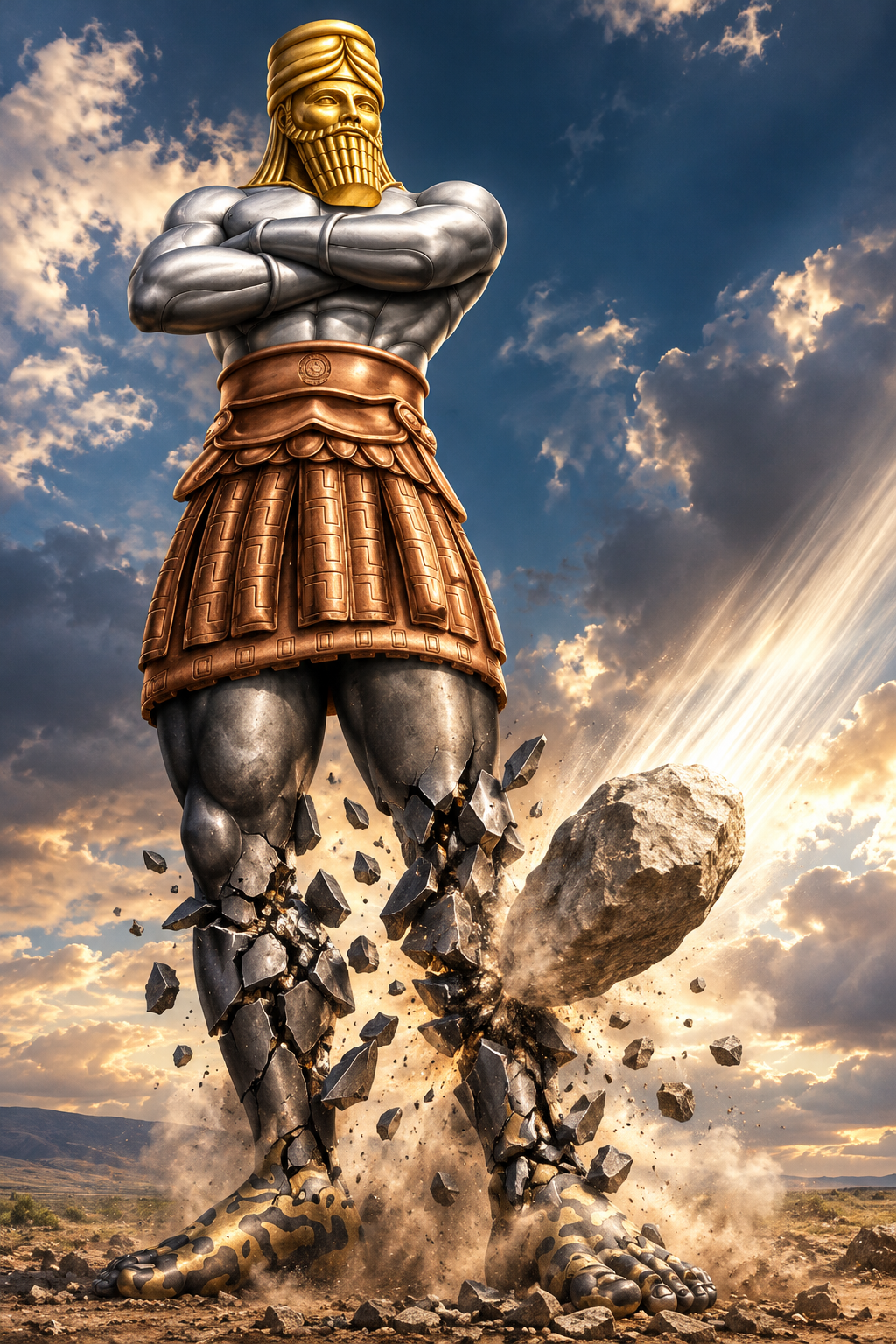
The king had dreamed of a great image. His head was made of gold. The chest and arms are of silver. The belly and thighs were made of bronze. The legs were of iron and the feet and toes partly of iron, partly of clay. Something happened as the king saw this image, a stone hit it and destroyed it.
So far, the telling of the dream. Then, the explanation.
The head of gold is the Babylonian kingdom, in the person of its most representative king, Nebuchadnezzar.
“You, O king, are a king of kings. For the God of heaven has given you a kingdom, power, strength, and glory; “and wherever the children of men dwell, or the beasts of the field and the birds of the heaven, He has given them into your hand, and has made you ruler over them all– you are this head of gold.” (v. 37-38)
These words echo those of the prophet Jeremiah:
“Thus says the LORD of hosts, the God of Israel– thus you shall say to your masters: `I have made the earth, the man and the beast that are on the ground, by My great power and by My outstretched arm, and have given it to whom it seemed proper to Me. `And now I have given all these lands into the hand of Nebuchadnezzar the king of Babylon, My servant; and the beasts of the field I have also given him to serve him. `So all nations shall serve him and his son and his son’s son, until the time of his land comes; and then many nations and great kings shall make him serve them.” (Jeremiah 27:4-7)
The Medo-Persians entered the city of Babylon some years after the death of the great Babylonian king. Nebuchadnezzar’s successors had brought shame and revolt in the kingdom and then Cyrus, the great Persian ruler, entered the city in triumph, welcomed by the oppressed subjects. By the time when this all happened, 70 years had gone by (606-536 BC). It was no coincidence since it had already been prophesied by Jeremiah some time before. “And this whole land shall be a desolation and an astonishment, and these nations shall serve the king of Babylon seventy years.” (Jeremiah 25:11).
The third kingdom, to follow after the Medo-Persians was that of the Greeks, “which shall rule over all the earth.” (Daniel 2:39)
Alexander the Great was a Macedonian by birth. He loved Greek culture, the songs of Homer, the heroes of the past (Ulysses, Achilles, etc.). His father died a premature death and he became king at the age of 23. He united the fragmentary Greek nation under one common goal: to seek revenge of the Persian Empire, that in the past had humiliated the Greek coalitions. So he moved to the mainland, and mesmerized by his excitement, his troops followed him. With sword in hand, advancing from the front line, Alexander led his army with his shining armor, like a beacon from one victory to another. He advanced along the coasts of the eastern Mediterranean, down to Egypt. All became his so easily. Afterwards, he moved towards his sworn enemy, Darius. At last, though the Persian king had the strongest and largest army of the time, Alexander defeated him and completed his mission.
But he wasn’t satisfied yet. He did not – maybe could not stop. Alexander moved farther: eastward. But at a certain point, even his generals thought going any further was only madness. Legend says Alexander cried: there were no more lands to conquer.
The largest empire of the world – till then – indeed deserved the description of the prophecy. It really ruled “over all the earth.”
Then came the fourth empire: the legs of iron of the image. Strong as iron, breaking in pieces and crushing all the others. The prophecy perfectly describes the Roman Empire, which would appear to dominate the world scene after the Greek. No one could resist the Romans – their military strategy, their political superiority, and certainly their way of dominating the subdued countries was unique. Yes, they were as strong as iron, crushing every resistance.
The legs are the longest part of the image, and it fits the description of the Roman empire, since it lasted on the world scene longer than its predecessors: the Babylonians, the Persians or the Greeks.
Then, before the end of this fourth kingdom, something happens, described by the symbolism of the feet and the toes, partly of potter’s clay and partly of iron.
The iron is there, so the strength. But a new element of division will weaken the kingdom, make it partly fragile. Iron can’t be properly mixed with clay. “They will mingle with the seed of men,” said the prophet, indulging here in his description. In particular, he is referring to the toes of the feet (v.42), that is the last part of the fourth kingdom.
The description of the image is complete.
One detail is quite significant. The prophecy clearly wants to point to one aspect of the history of mankind. Though we see evolution and progress. Though we are all advancing in hope for a better future, somehow all our efforts are not producing the desired results. We think we are better than the Greeks of Alexander. Better than the Persians of Cyrus. Better than Babylonians. Better than all those who have been on the planet before us. Maybe our technology is the most advanced in the history of mankind. But following God’s standards, history has not been upward but a moral, political, social decline.
The head of the image was of gold. Then came the silver. Then the bronze. Then the iron. And, in the end the catastrophe: the impossible mixture of clay with iron. The image is destined to collapse. Iron is strong, but clay will weaken it to the point that the feet and toes won’t be able to bear the weight of the whole image. But before that happens, a special, divine intervention will put an end to human efforts for a perfect world. God Himself will step into the scene and establish his own kingdom.
A stone strikes the image on its feet and breaks the clay and the iron. The rest of the image is crushed too. Then the stone becomes a great mountain and fills the earth. In the interpretation, the prophet declares the meaning of this: “the God of heaven will set up a kingdom which shall never be destroyed.” (2:44)
It is quite understandable why the Jews had such strong Messianic expectations during the first century of our era. The times were mature. The Romans, the fourth kingdom, whose coming had been foretold here, were in power.
When Jesus comes back, he will destroy the last kingdom on earth, that of the Antichrist and establish his own everlasting kingdom. We will see this in detail when discussing the vision told in Chapter Seven.
Josephus was a Jewish historian that lived in the first century. He wrote many books of undisputable value. In “The Antiquities of the Jews” he mentions Daniel and his interpretation of the Babylonian king’s dream. “Daniel did also declare the meaning of the stone to the king; but I do not think proper to relate it, since I have only undertaken to describe things past or things present, but not things that are future.” The Jewish historian could not openly disclose in his writings, addressed to the Gentiles, the non-Jewish, that the Romans would have been destroyed by God himself who was to finally establish His kingdom on earth.
In the same way, it is not easy for me to tell this world that its efforts to build a world government without God is destined to collapse and that before it does fall, Jesus will appear on the scene and put an end to the useless human efforts.
Concerning these events, the book of Revelation has this to say:
“Now I saw heaven opened, and behold, a white horse. And He who sat on him was called Faithful and True, and in righteousness He judges and makes war. His eyes were like a flame of fire, and on His head were many crowns. He had a name written that no one knew except Himself. He was clothed with a robe dipped in blood, and His name is called The Word of God. And the armies in heaven, clothed in fine linen, white and clean, followed Him on white horses. Now out of His mouth goes a sharp sword, that with it He should strike the nations. And He Himself will rule them with a rod of iron. He Himself treads the winepress of the fierceness and wrath of Almighty God. And He has on His robe and on His thigh a name written: KING OF KINGS AND LORD OF LORDS.” (Revelation 19:11-16)
The express declaration of the king shows he was a wise man. In fact, he acknowledges the God of Daniel and proclaims: “Truly your God is the God of gods, the Lord of kings, and a revealer of secrets, since you could reveal this secret.” (Daniel 2:47)
I wish our world leaders and rulers would read this chapter of the Bible and fall on their faces to worship God and not to power and money as they obviously do.
May God open the mind of each individual and live acknowledging Him as Sovereign Ruler of the Universe and of our lives individually. I really pray that the meditation of this portion of Scripture might lead some to do so.