

by Giuseppe Guarino
Click here to read the pdf of the article ONE HOUR TO FALL IN LOVE WITH GREEK
Give me just one hour of your time to let me try to make you fall in love with Biblical Greek, the original language of the New Testament.
I will do my best so that, by the end of this lesson you will:
1. love Greek
2. know John 1:1 by heart.
John 1:1 reads, ᾿Εν ἀρχῇ ἦν ὁ Λόγος, καὶ ὁ Λόγος ἦν πρὸς τὸν Θεόν, καὶ Θεὸς ἦν ὁ Λόγος.
Click on the bar to listen and learn how to pronunce it.
1. HOW DID THE NATION OF ISRAEL GET IN TOUCH WITH GREEK CULTURE AND LANGUAGE?
In 323 BC Alexander the Great was born. He united the independent cities of Greece against the common enemy, the Persian empire. In less than 10 years he conquered the whole known world.
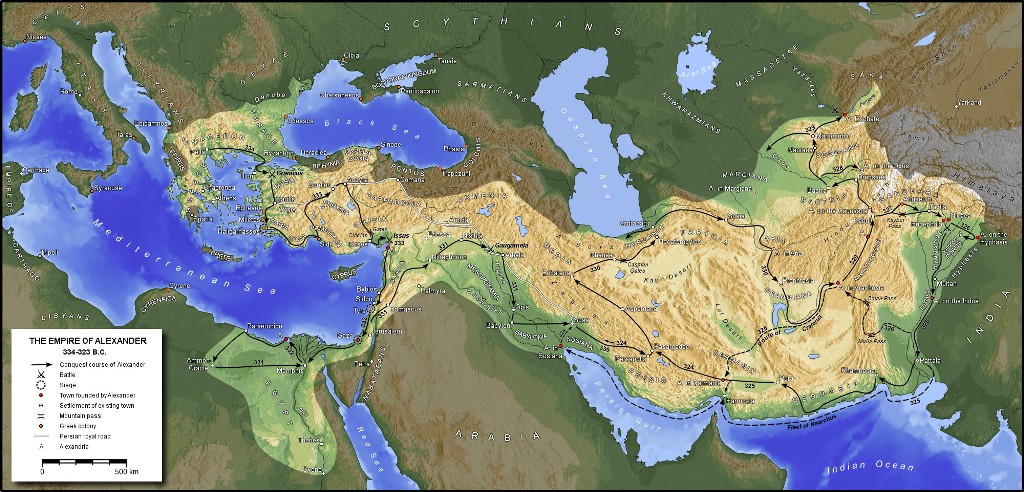
He died at age 33 in Babylon. Hellenism is the influence of Greek culture and language that followed his conquest. Greek became, like English today, spoken everywhere and used for commerce and trade.

In c. 250 BC, in Alexandria of Egypt, the Torah, the books of Moses, were first translated in Greek. That is how the famous Septuagint was born.

The Jewish historian Josephus (AD 37 – 100) will tell this story in detail. A few years before, the Jewish philosopher Philo of Alexandria (20 BC – 50 AD) wrote extensively with apologetic and philosophical style on behalf of the Jewish religion. Of course both wrote in Greek.
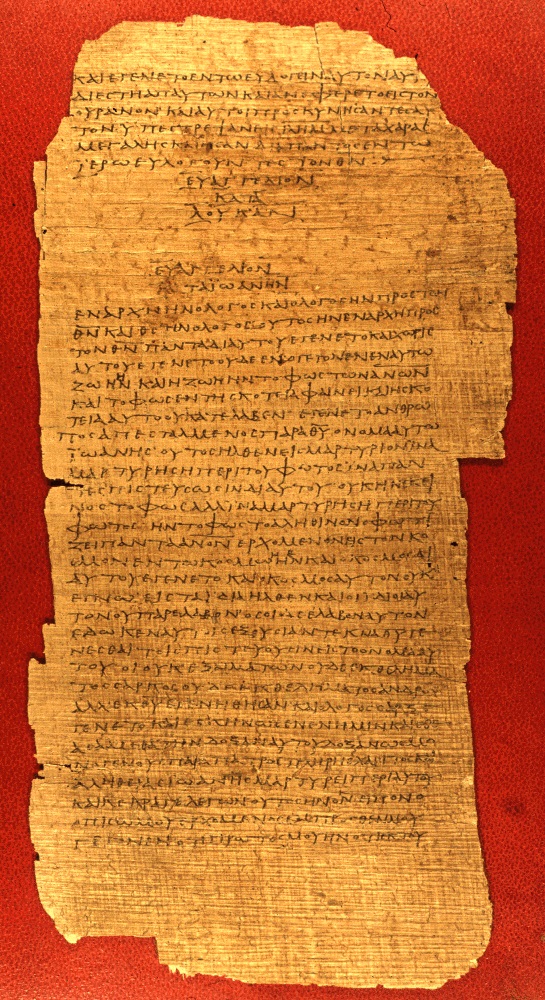
P75 a c. 200 AD Papyrus of the New Testament
2. WHY WAS GREEK CHOSEN AS THE LANGUAGE OF THE NEW TESTAMENT?
Even though the Romans were in power when Christianity was born, Greek was still the language spoken everywhere. It is was natural and obvious that the apostles and the early Church would use this language for the composition of the New Testament.
So it was natural that Paul and Luke wrote in Greek for the non-Jewish converts in Rome, Corinth, Thessalonica, etc. Some say there was a Hebrew original for Matthew and Mark. They must have relied on Hebrew witnesses, both written and oral, but there is little or no doubt that they were originally written in Greek. The same applies to John as it is evident from the language of this Gospel – which probably was written in Ephesus. No serious doubts have been convincingly stated in favor for (lost) Hebrew originals of other books of the New Testament.

The Greek they used was Biblical Greek, a variant of koinè Greek, the language of the Septuagint.
Some quick evidence that the NT was written in Greek:
a. John 1:41, The first thing Andrew did was to find his brother Simon and tell him, “We have found the Messiah, which is, being interpreted, the Christ.” No translator would have taken the freedom to retain the Hebrew word and then translate it in Greek.
b. We find it in the NT consistently but it is Hebrew. And so are many words and sentences throughout the NT: this is not how a translator operates. Alleluia, Abba, Maranatha, etc.
3. WHY STUDY GREEK?
- It was never so easy as it is today. You can use apps, videos, my course, academic level, basic knowledge, quietly sitting in your living room.
- A basic knowledge of the alphabet will enable you today to benefit from apps that give you information in minutes that it took hours to collect in the past. Biblehub.com is an amazing website, and it is also an app.
- Having access to Greek you will be able to enjoy details that a translation cannot fully render. (Many of the differences from one translation to another are due to this ).
4. SOME PRACTICAL EXAMPLES
α. John 3:3, the Greek ἄνωθεν can mean both “again” and “from above.” Reading the Greek you get both, because one does not exclude the other, we are born again as we are born from above.
β. John 6:40 reads in the NIV, “For my Father’s will is that everyone who looks to the Son and believes in him shall have eternal life, and I will raise them up at the last day.” The translation is basically correct. But the original Greek word translated here with “to look to” is “θεωρέω.” Just to give you a quick idea, I can say that this is where the English word “theater” comes from. And we know that in a theater, when you sit and watch – and listen too – you do it in a special way, paying attention in order to understand exactly what is going on on the stage. This is what the Greek verb here implies and we have no verb in English to fully render that. There are other verbs in Greek to convey the idea of the English verb “to see,” namely, βλέπω and ὁράω. So, when the apostle uses that verb he has in mind: “θεωρέω depicts concentrated, discerning observation. It is more than a glance (βλέπω) and more deliberate than simple sight (ὁράω). It carries ideas of beholding with intent, investigating, and drawing conclusions. The term stands behind the English word “theory,” pointing to thoughtful reflection upon what is seen. In Scripture it often marks the crucial divide between those who merely witness an event and those who grasp its significance.” Source: Bible hub, on John 6:40.
γ. John 1:1-2. In the prologue of John we learn that the Word was – in Greek it is “ἦν,” Imperfect Indicative Active of the verb “εἰμί,” “to be.” So John uses this specific verb to express the eternity of the Word, the Logos, because it implies that “In the Beginning the Word already existed.” He repeats that in verse 2, because he wants to make it clear that the Word was also in reference to what he says in verse 3: “All things were made by him.” (KJV), “Through him all things were made” (NIV) do their best to translate a Greek text which is basically impossible to translate in English. It is: “πάντα δι᾿ αὐτοῦ ἐγένετο”, “through him all things came to be.” ἐγένετο is Aorist Indicative Middle of the Greek verb γίνομαι which is a way of saying “to be” but in the sense of “coming to be,” in short it implies a “change of condition.” So, the Word was in an absolute sense, it had life in himself, but the world came to be through the Creation, in which the Word had a main role.
Am I a genius? No. Today, it is so easy. I could have used a vocabulary, look at my grammars or commentaries, but not today. All you need is some basic Greek knowledge and a good Bible software or even app. See Bible hub for example.

Now that we have learned about those two verbs we look at John 8:58 it speaks of Jesus as the “I AM” (ἐγὼ εἰμί) and of Abraham as “coming to be” (γίνομαι). We could dare translate the passage as “before Abraham came to be (he had a beginning), I am (I never had a beginning).”
δ. Revelation 1:8. The Greek word παντοκράτωρ is actually found in the Septuagint to render the Hebrew Sabaoth, and it is usually translated “Almighty.” A word literally created by the Septuagint translators to universalize the Hebrew original. The sentence that precedes it in Revelation 1:8 is, “the Lord God, ‘who is and who was and who is to come’” which is a translation into Greek of the Hebrew name of God YHWH, Jehovah. So in Revelation 1:8 John gives us a Greek rendering of the original Hebrew sentence usually translated in English as “The Lord of Hosts.”
For the sake of time we stop here.
 |
 |
 |
Knowing some Hebrew (עִבְרִית) would help too. But that would take another hour – may be some other day…
Please consider studying using my BIGOL – Biblical Greek Online Lessons.

I wrote several books on the fascinating topic of the Old and New Testament languages. I hope they will help you learn more about the original languages of the Bible. Click on the cover to know more about the title you choose or buy it on Amazon.
 |
 |
 |
 |
 |
 |
 |
|